

The Seven Woes, Part one of three / RLM / June 2025
What is “woe”?
woe / ouai / expressing extreme displeasure and calling for retributive pain on someone or something (ANLEX). A state of intense hardship or distress — disaster, horror. (Louw-Nida).
It’s safe to say that Jesus was angry sometimes. He was angry in the temple at the abusive money changers cheating people — his zeal consumed him. He was angry when he saw the shallowness of the people before he healed a man with a withered hand on the Sabbath. There are a few instances in the Gospels like this, but all of these are almost tame compared to this discourse.
Here Jesus calls out seven woes on the scribes and Pharisees for hypocrisy. I believe its not just their hypocrisy that Jesus is angry about. It is the effect they have on the citizens of Israel. They should be better than this, they should be helpful and loving toward others — and they are exactly the opposite of what they were. But, because their hearts are human like ours, sometimes they cannot see the damage they are doing, and are not open to learning.
Woe 1 / The Effect on Others: Pulling People Away from Jesus (23:13)
Matthew 23:13-14 / “But woe to you, scribes and Pharisees, hypocrites! For you shut the kingdom of heaven in people’s faces. For you neither enter yourselves nor allow those who would enter to go in.
—–
To say this is utterly unconnected from the verses that proceed it is folly. This verse and this injunction against the religious leadership class of Jesus’ day has everything to do with what came before.
The main point in Matthew 23:1-12 is that these false leaders were usurping the role of God as teacher and doing so in an abusive way is very much on point with this passage.
They are about silencing the truth of God. People like this killed the prophets in days of old so people could not hear God’s word. They were people who were going to be about making sure Jesus’ life and words would not continue. They were actively discrediting Jesus as a leader and as a teacher, though he had the words of life. They were literally “shutting the kingdom of heaven in people’s faces.”
It is of note that in each of these instances there are two groups involved. The perpetrators, and their victims. Their leadership techniques and tendencies always have deleterious effects on others — and that is why Jesus is angry. What happens to themselves is one thing, that they cause harm in others is quite another.
Woe 2 / The Effect on Others: Making Their Disciples Worse Than Themselves (23:15)
Matthew 23:15 / Woe to you, scribes and Pharisees, hypocrites! For you travel across sea and land to make a single proselyte, and when he becomes a proselyte, you make him twice as much a child of hell as yourselves.
—–
A lot of effort and time put into making someone twice as bad as the generation before him. Double trouble. The effects of their doctrine do not bring them closer to God or to the Lord, but further and further away.
Legalism is a black hole that Christians cannot swim out of. It sucks them down. Hypocrisy is another such hole. There is no logical end other than frustration and ruin. Who can do “enough” to be right with God, who can look “good” from an external stance forever? Won’t the mask slip?
One commentary had the descriptive phrase; “they [the Pharisees] were more partisan than pious.” They were about ideology and politics, not about true holiness and faith. They were as Paul stated people who sought people to follow their movement, and not the Lord.
So, in this instance it is the convert who is made to suffer, as he becomes “twice as much a child of hell” as them.
Woe 3 / Their Teaching Content: Lying, Word Games, Manipulation and Obfuscation (23:16)
—–
Matthew 23:16-22 / “Woe to you, blind guides, who say, ‘If anyone swears by the temple, it is nothing, but if anyone swears by the gold of the temple, he is bound by his oath.’ You blind fools! For which is greater, the gold or the temple that has made the gold sacred? And you say, ‘If anyone swears by the altar, it is nothing, but if anyone swears by the gift that is on the altar, he is bound by his oath.’ You blind men! For which is greater, the gift or the altar that makes the gift sacred? So whoever swears by the altar swears by it and by everything on it. And whoever swears by the temple swears by it and by him who dwells in it. And whoever swears by heaven swears by the throne of God and by him who sits upon it.
—–
The Pharisees seemed to be all about word games. People would “swear” by certain things to show the truthfulness of their words, then wiggle out of it by saying that the thing that they swore on did not make the promise binding. Word games.
We should just tell the truth, and be honest, and not play games. Elsewhere in scriptures we are told not to be people who practice these things, but rather people who make their “yes” yes and their “no” a no.
Here are people who use their religious affiliations and positions a part of their deceptive practices. They are first and foremost deceptive, and wanting to deceive.
Jesus calls them three different variations of “blind” — guides, fools, and men. A guide is an instructor of an ignorant man, he is saying that this instructor of the simple (a guide) is not capable of this role, he himself doesn’t know which way to go. A fool is a dull, sluggish, dull and stupid person. They don’t look like this, but this is who they are. They have all the appearance of a righteous one with the right clothes and the right words — but are hapless and dangerous.
Woe 4 / Their Teaching: Majoring in the Minors, Minoring in the Majors (23:23)
Matthew 23:23-24 / “Woe to you, scribes and Pharisees, hypocrites! For you tithe mint and dill and cumin, and have neglected the weightier matters of the law: justice and mercy and faithfulness. These you ought to have done, without neglecting the others. You blind guides, straining out a gnat and swallowing a camel!
__
Someone once said that one of the worst ways to be a leader in the church is “majoring in the minors.” The Old Testament had many commands, obviously, but what if we focus only on the simpler pieces, the little bits, but ignoring the “weightier matters.” This word seems to indicate that these were the bits of the law that were the most significant, yet difficult, yet important parts. Jesus might have said in our legal context, “you are all so invested in not jaywalking, and not littering that you forgot to obey that one part about not murdering your neighbor.”
Both were important, but one was laid upon the trash heap when it should have been your focus.
These weightier matters are;
Justice / Having discernment and judgement of matters. Knowing what is right and wrong and keeping them pure. Treating people fairly and not prejudicing or showing preference to self or others.
Mercy / Kindness or concern expressed for someone who is in need. Compassion of heart. Care for the individual more than a strict pursuit of other parts of the law.
Faithfulness / being trustworthy and faithful. Being honest.
Putting these things together, a person who is void of these main aspects of the Law is someone who has lost discernment, rejects people who are truly in need, and are not trustworthy because of a lack of honesty.
Are we more concerned with the minor things in life or the more weighty things? This is a part of our Christian culture and of our hearts to this very day.
Then, in summary the little proverb that is so memorable; straining gnats and swallowing camels.
This is a proverbial saying, by which he beautifully describes the affected scrupulousness of hypocrites about trifling matters; for they utterly shrink from very small faults, as if a single transgression appeared to them more revolting than a hundred deaths, and yet they freely permit themselves and others to commit the most heinous crimes. They act as absurdly as if a man were to strain out a small crumb of bread, and to swallow a whole loaf.11 John Calvin and William Pringle, Commentary on a Harmony of the Evangelists Matthew, Mark, and Luke, vol. 3 (Bellingham, WA: Logos Bible Software, 2010), 92–93.
Majoring in the minors, minoring in the majors. Missing the bigger points and making much out of smaller, trivial things. Beware these people, they get you off track in a very dangerous way. They pull you further into hell, while promising heaven.
This represents 4 of the 7 woes, with more to follow next post.


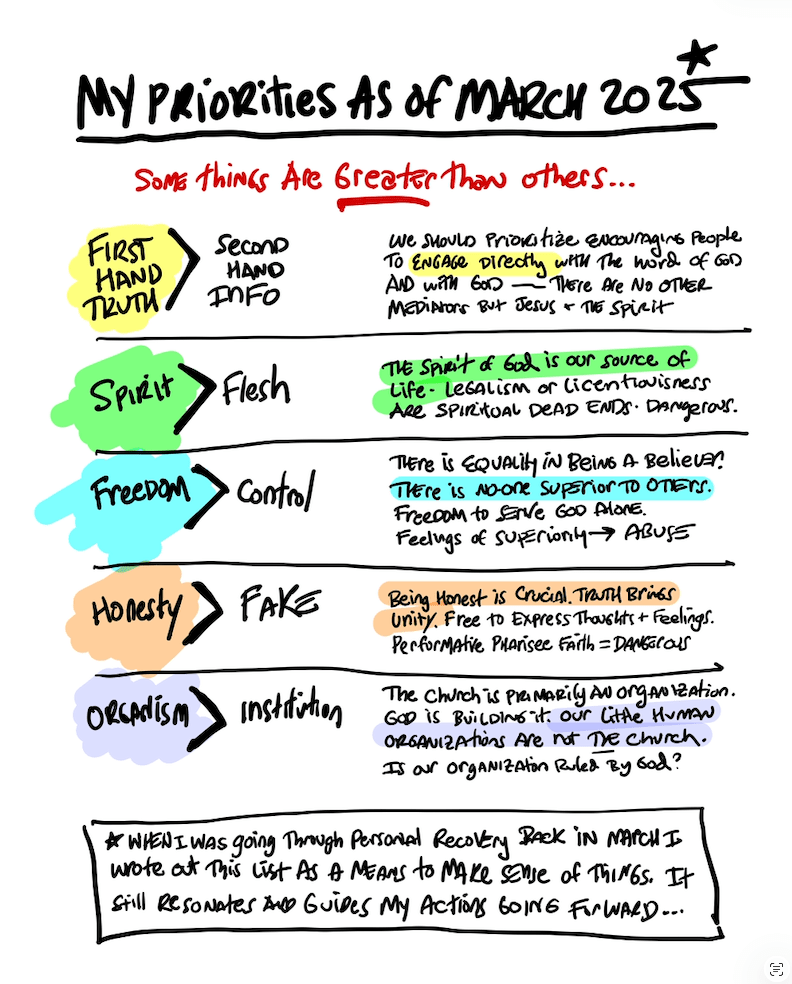

 First Hand Truth
Leave a comment