

Mutual submission of the servants of Christ / a pattern to follow
Rick McNally / Aug 2025
Consider doing a self-study on one of the five topics discussed this morning. They can be found here. Also, consider reading my introduction to First Hand Truth found here.
Also, here are my message/sermon notes on the entire passage from 1 Corinthians 16:12-24, from a sermon at Calvary Baptist in Battle Creek.
1 Corinthians 16:15-16 / Now I urge you, brothers—you know that the household of Stephanas was the first converts in Achaia, and that they have devoted themselves to the service of the saints— be subject to such as these, and to every fellow worker and laborer.
We are here given an example, and then asked to follow that example.
When some of us read this, we will prejudice these verses, and I would ask that you not. Some believers and authorities believe themselves to be the ones to be obeyed — not the ones who should also submit. This is a very dangerous idea.
This idea stems from (1) personal and corporate arrogance and (2) from a selective hearing of the concepts of authority in Scripture. Let’s take a few minutes to unwrap these two verses and see if we can see what is in Paul’s mind.
Herein is the living out of Philippians 2, in two sentences.
He begins with the urging, we will return to this initial word as we combine it with the final phrases.
As he gets to his topic slowly, he talks about the household of Stephanas and describes them as the first converts in Achaia — this region is in Greece encompassing the southern peninsula of that area. A household is an entire “compound” of people who make up a family unit — a few generations, and household servants and the like. This is what is likely implied by this Greek word and the culture of that time. It was a whole compound of people in Paul’s mind.
Well, this compound, and perhaps the leadership of Stephanas at some point, made a decision to help, in word and in deed, the service of the saints. They decided to become “diakonia” or “table servants” of the saints and their works. This is our word deacon; to serve others with what you have to offer.
This entire household became like servants to the other people of God. Some commentaries here hint that the church at large was probably not all that impressed with this — that perhaps they thought it was a lowly activity and not worth their time or respect.
Back to Paul’s urging. To urge at the beginning of our passage of study means “to beg, encourage, request, implore.” It is the word parakalō, it means to come alongside and speak words of encouragement. He is urging us to do something, and that is to find it within our house to not just let others serve, but follow their example of true servanthood.
Servanthood is not just a good idea for some in the Body of Christ — it is the heartbeat of our fellowship together.
Be subject to such as these.
Paul says to us, you see those kinds of people who are bending over backward and serving you, subject yourselves to the servants.
We should be willing to see people who serve and submit to them and show to them that we don’t consider ourselves above them, but consider ourselves “less than” and others greater than [Philippians 2]. The flesh — the old nature — will clamber for people to serve us and point out our supposed superiority. The Spirit will push for our mutual bended knees.
After his urging to subjection to these kinds of people, he expands it.
…And to every fellow worker and laborer.
Now you go too far. The call to “subject” ourselves is a call for all Christians everywhere to submit to other fellow Christians who are about the work of Christ. Where is the top? Where is the head? Who’s in control? Jesus. He is the head of the Church. We are not.
The call here includes “fellow workers” which are “synergounti” — those who “engage in activity together with someone else,” or those who work together. This category is expanded by the phrase “laborer,” which gives the impression that the work is hard and the work takes a toll on a person. Do you know people who serve the Lord and toil? They are the kind of people that are to be “subjected” to.
If you have been following the plot, it looks like this:
- • Stephanus’ household serves and respects people who are serving God.
- • Paul encourages the Corinthians to serve and respect those people in turn.
- • Paul encourages the Corinthians to serve all such people in this way.
This is mutual submission. There is no “top of the heap” here, but all of us serve each other. The word every is in there.
What if we treated each other this way? If Christ is our Lord and his word is the thing that we serve — we will. We would. We should. We should repent and confess when we do the opposite.
What gets in the way of this? Human sin. Arrogance. Misguided authority structures. Misguided desires to be “over others” or “seem important.” Those kinds of behaviors cause and create more of the same, begetting problems and more problems. This is the poison of Corinth at the time of Christ — everybody had factions and desired others to follow them.
This was the request of the Brothers as they walked with Jesus, to be on Jesus’ right and left hand;
What they really expect is a kingdom for themselves, where they can impose their own will on others. They hope to replace the self-serving oppressive power structure of the Romans with their own self-serving oppressive power structure. Nothing changes except the names of the rulers. Oppressive power gets recycled and new tyrants rise on the scene. The worldly ambition to be at the top and to beat down others still rules. David E. Garland, Mark, The NIV Application Commentary (Grand Rapids, MI: Zondervan Publishing House, 1996), 411.
To be a servant — to serve others and put others above ourselves. This is the way of Jesus.
It’s something to emulate, if anything is.


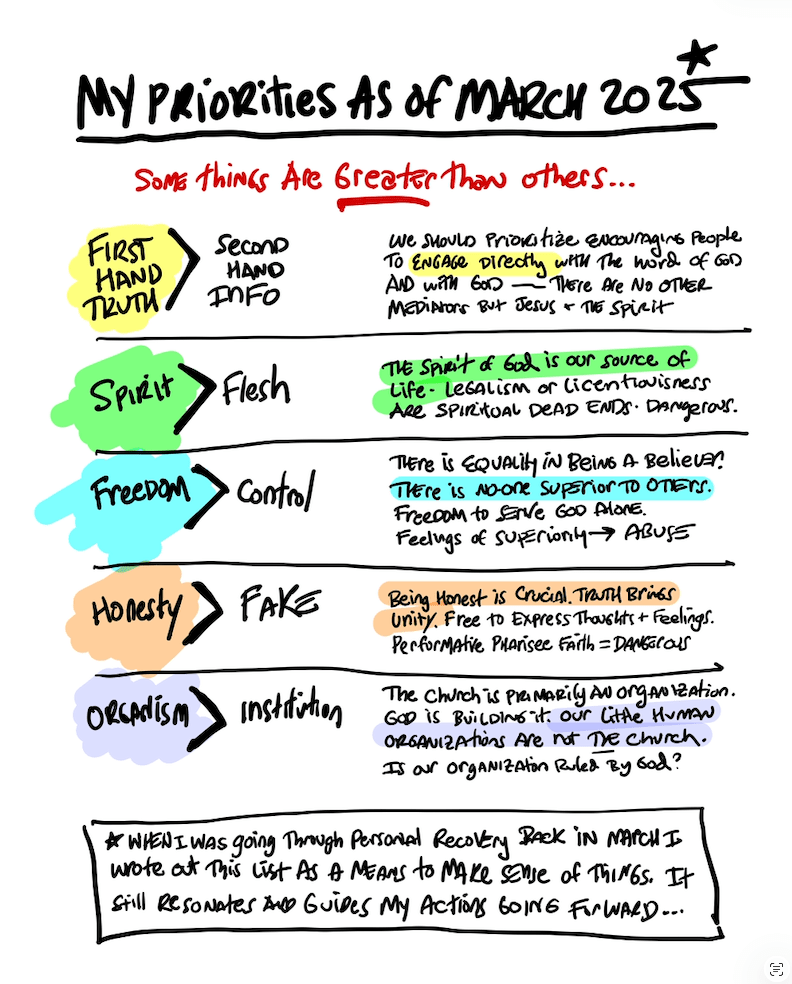



 First Hand Truth
Leave a comment