

The Servant Songs of Isaiah / Part 1 / Isaiah 42:1-9 / Rick McNally
Something is wrong in the world. We all can feel it. Something is broken.
It’s not just with society, with governments, with the people we know and the things they do — if we are honest, something is wrong with us too.
We keep hoping something will change it completely and make it right. But it doesn’t matter; nothing seems to satisfy us or fix the ills of this world. It’s broken. We are broken.
The Old Testament peoples knew this too. To fix the brokenness, God said he would send a messiah — an anointed one. He told us he would be part prophet, part political leader, part priest. These hints and prophecies are scattered throughout the pages of the Old Testament, scattered in nearly every book and on many, many pages.
One of the places is found in Isaiah, in what has come to be known as the “Servant Song.” This name was put forward by a theologian named Duhm in the early 1890s in a commentary. These refer to four particular passages (maybe less, maybe more) that have some striking prophecies regarding the person and work of this coming Messiah: who was he going to be, what was he going to be like, what was he going to do?
We will examine the first of these songs today.
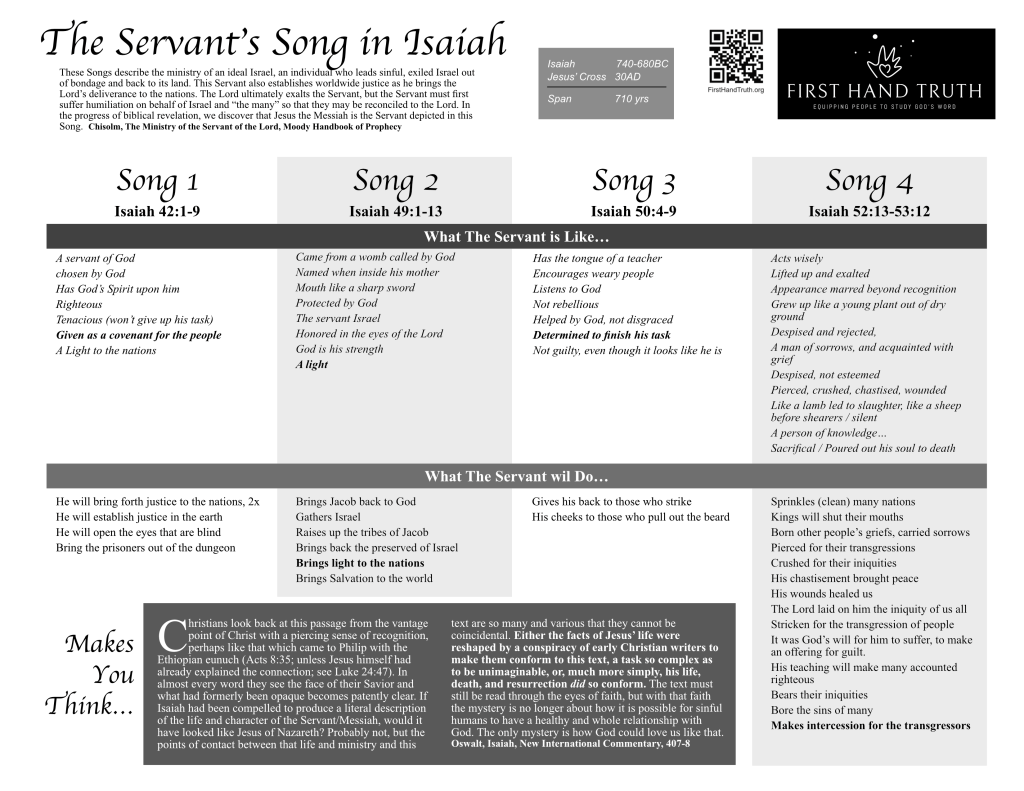
The First Servant Song / Isaiah 42:1-9
The first of four Servant Songs in the latter half of the book of Isaiah tells of
- The Servant’s identity / what he will be like
- The Servant’s work of establishing justice / and his unique way of doing so
- The Lord’s deep relationship with the Servant during that work,
- and a declaration by the Lord of his utter command of this world.
God’s Servant Will Be Like This…
Behold my servant, whom I uphold,
Isaiah 42:1a (ESV)
my chosen, in whom my soul delights;
I have put my Spirit upon him;
Here we see God saying he has a special servant in mind for a special task. He is a “kind” of replacement for Israel as a nation, who was supposed to be his servant, but failed. This one will not. Here are his descriptions;
Behold my servant, whom I uphold;
This will be a singular servant, one whom the Lord, Yhwh himself, will uphold and support in his task.
My chosen;
This is the term that means chosen, personally picked out, personally selected by God for a task. This term was used of Moses (Psalm 106:23) and David (Psalm 89:4), and more generically the Israelites (Psalm 43:20, 45:4).
God chose this person.
In whom my soul delights;
The Lord loves this person, is pleased with this person, is satisfied with him. God does delight in his people, but here it seems a bit more so. There is nothing to dislike about this individual — he is the perfect servant, the one who not only does the Lord’s bidding, but is the apple of his eye.
If this person, Messiah, is the Lord Jesus, who many think him to be — we see this language in the New Testament recording the Father’s view of Jesus.
- Matthew 3:17 / and behold, a voice from heaven said, “This is my beloved Son, with whom I am well pleased.”
- Matthew 17:5 / He was still speaking when, behold, a bright cloud overshadowed them, and a voice from the cloud said, “This is my beloved Son, with whom I am well pleased; listen to him.”
- Mark 1:11 / And a voice came from heaven, “You are my beloved Son; with you I am well pleased.”
- Luke 9:35 / And a voice came out of the cloud, saying, “This is my Son, my Chosen One; listen to him!”
Jesus was the Delight of the Father, the Servant was the Delight of Yhwh.
God’s Servant will Accomplish These Things, this Way…
He will bring forth justice to the nations.
Isaiah 42:1b-4 (ESV)
He will not cry aloud or lift up his voice,
or make it heard in the street;
a bruised reed he will not break,
and a faintly burning wick he will not quench;
he will faithfully bring forth justice.
He will not grow faint or be discouraged
till he has established justice in the earth;
and the coastlands wait for his law.
This is a new kind of leader, a new kind of King, one made of different stock than any leader I’ve ever met. This one does not raise his voice in anger, shout in the streets to be heard. He’s not a boisterous one. This one does not break people below him on the way up (or to keep his position), or drown the barely burning wick. This one is not a bully, quite the opposite, in fact. Some believe you have to break a people along the path as metaphorical “eggs” in order to make a metaphorical “omelette.” No, not so. People are important to him, all people.
Not only is there a sense of kind compassion here, but also the tenacity of someone who will not give up on his goal — his Lord’s goal. Though the goal is important, the Servant will not go against the character that the Lord possesses — or the character he himself possesses — to accomplish them. By the fourth of these “servant songs” we will see to what length the Servant was willing to go to bring an otherworldly compassion to the world.
His work is not small, it is the bringing forth of justice to the entire world, even to the “coastlands” which indicate that this justice will go to the farthest reaches — to even the gentiles. Worldwide justice. Worldwide peace.
Justice in the Old Testament is a theme that is sometimes skimmed over in some people’s minds. It is more than punishing the wrongdoers. It is about protecting and respecting everyone, providing clear justice for the weak and neglected. It requires righteous principles followed without any favoritism, but with truth and compassion. It is an important theme:
- Micah 6:8 / He has told you, O man, what is good; and what does the Lord require of you but to do justice, and to love kindness, and to walk humbly with your God?
- Isaiah 1:17 / Learn to do good; seek justice, correct oppression; bring justice to the fatherless, plead the widow’s cause.
- Prov 21:15 / When justice is done, it is a joy to the righteous but terror to evildoers.
- Amos 5:24 / But let justice roll down like waters, and righteousness like an ever-flowing stream.
- Isaiah 30:18 / Therefore the Lord waits to be gracious to you, and therefore he exalts himself to show mercy to you. For the Lord is a God of justice; blessed are all those who wait for him.
True justice is closely entwined with righteousness (Psalm 33:5), or true and good character and behavior. These two are inseparable and part of the nature of God himself. If he were not good, he could in no way provide true justice. If he were not just, he would not be good. Since people are fallen beings, we can no way bring perfect justice because we are not perfectly good. This does not mean we shouldn’t attempt such with honesty, respect, love, and compassion. But God’s justice is perfect, and to this day is not fully realized in this world.
God’s Interaction and Support of the Servant…
Thus says God, the Lord,
Isaiah 42:5-7 (ESV)
who created the heavens and stretched them out,
who spread out the earth and what comes from it,
who gives breath to the people on it
and spirit to those who walk in it:
“I am the Lord; I have called you in righteousness;
I will take you by the hand and keep you;
I will give you as a covenant for the people,
a light for the nations,
to open the eyes that are blind,
to bring out the prisoners from the dungeon,
from the prison, those who sit in darkness.
This section begins with God’s declaration of being the maker and creator of the world. This is the context of what he is speaking of. He has the right to make these decrees, he has the right to call the Servant to his task. From the making of the skies and heavens, to the folds and streams of the earth, to the people who walk on its crust. The breath that they breathe is his breath, the spirit that animates them is his as well.
Now, this next bit is beautiful. It is Yhwh, the God of gods, the King of kings, speaking to his Servant. There is intimacy here.
This is like a commissioning of the Servant with the task that defines the world to this day.
God (Jhwh) is speaking, and speaking to the Servant. We are let in on this conversation that happened between the Lord and the Servant.
The servant is called in righteousness, taken by the hand and kept, given as a covenant for the people, and as a light to the nations.
To be called in righteousness states that this Servant is a righteous person, one to whom the Lord himself delights. This is in contrast with the nation of Israel whom Isaiah and God proclaim throughout the book their inability to be righteous in their actions. This one is righteous.
His task is such that the cooperation of Jhwh is required, assistance is necessary. This will be a task that will need the help of Jhwh and the ability to sustain and uphold the Servant will come directly from an intimate relationship with him.
He will be a covenant for the people. The Israelites have experienced a number of covenants between God and man. Noahic, Abrahamic, Mosaic, and Davidic to mention the high points.
The Noahic covenant surrounds the idea that God would never again destroy the people of the world with a flood. The Abrahamic covenant is God making a special relationship with Abraham that would include God’s help in making him a special people, and that through his people to provide a blessing to all mankind. The Mosaic covenant is God providing the Israelites a list of what God expects from their new nation, and that there is an escape route of confession and sacrifice for those who admit their failures. It was not about keeping the laws, it was about recognizing that they couldn’t and would need to come to God in confession to repair their relationship. The Davidic covenant was about a special relationship God had with David, and the promising of a unified line of succession between him and a coming Messianic king.
The covenant of Messiah — the New Covenant — would encompass and surpass each of these themes. As Walter Kaiser puts it, “One three-part formula acts as a summation of God’s covenant relationship: I shall be your God, you shall be My people, and I shall dwell in the midst of you.” (Kaiser, Holman Concise Bible Commentary, 1998). The new covenant would provide that but all the more so, as people would enjoy God’s very presence one day, and until that day have the unheard-of indwelling of the Holy Spirit as a daily intimate benefit.
- Noahic / God would not destroy the earth with water again, but will at some time remake the world anew.
- Abrahamic / The Messiah would be a direct fulfilment of the idea that God was going to bless all nations through Abraham.
- Mosiac / The Law was written on tablets, but God’s new law would be written on human hearts for the awareness of sin, with the benefit of the Holy Spirit indwelling people to make goodness possible. Jesus was the ultimate fulfilment of the Mosaic Law, as he alone embodied its character — the Law was a prophecy of Messiah.
- Davidic / The Messiah would be “like David” in character, but even more so. The Messiah would be a son of David and the rightful king of Israel.
The last phrase in this passage is “a light of revelation to the nations.” As has been hinted above, God was — through Messiah — interested in bringing about a dramatic change for not just Israel but the whole of the world. Such was the scope of this parable, and such was the scope of Jesus’ ministry as it began, and as it continues.
The Benediction
I am the Lord; that is my name;
Isaiah 42:8-9 (ESV)
my glory I give to no other,
nor my praise to carved idols.
Behold, the former things have come to pass,
and new things I now declare;
before they spring forth I tell you of them.”
This passage acts as a benediction of sorts, reminding us who is speaking. He alone is God. None other are as glorious. Idols are a joke before him and deserve no “praise.” God alone.
The things that have happened have happened. Now, he is uttering “new things” that will one day come to pass, and God is telling us about them “before they spring forth.” This is a good definition of prophecy. God speaks of things that no one else could possibly know about because he planned them beforehand.



 First Hand Truth
Leave a comment