
Rick McNally / July 1, 2025
A friend of mine died this week. No, I only ever just shook his hand one time, and that was a few years ago. Not even sure what kind of a man he was, really. But I want to thank him today just the same.
His name was Jim Shooter.
If you knew a bit about comic books, you might have heard of him. He sold his first comic book story at the age of 13, when most of us were still trying to figure out the difference between an inanimate object and a direct object. He later went on to be the Editor-in-Chief at Marvel Comics in the 1980s. He had a storied career.
My connection with him began as I was an 11-year-old collecting Marvel Comics. Yes, the good old days of 1977 were when I started looking in the local drugstore for these colorful marvels. I ran into them earlier on vacation with my grandmother and grandfather — I found a beat-up issue of Iron Man and devoured it. Now I was a collector.
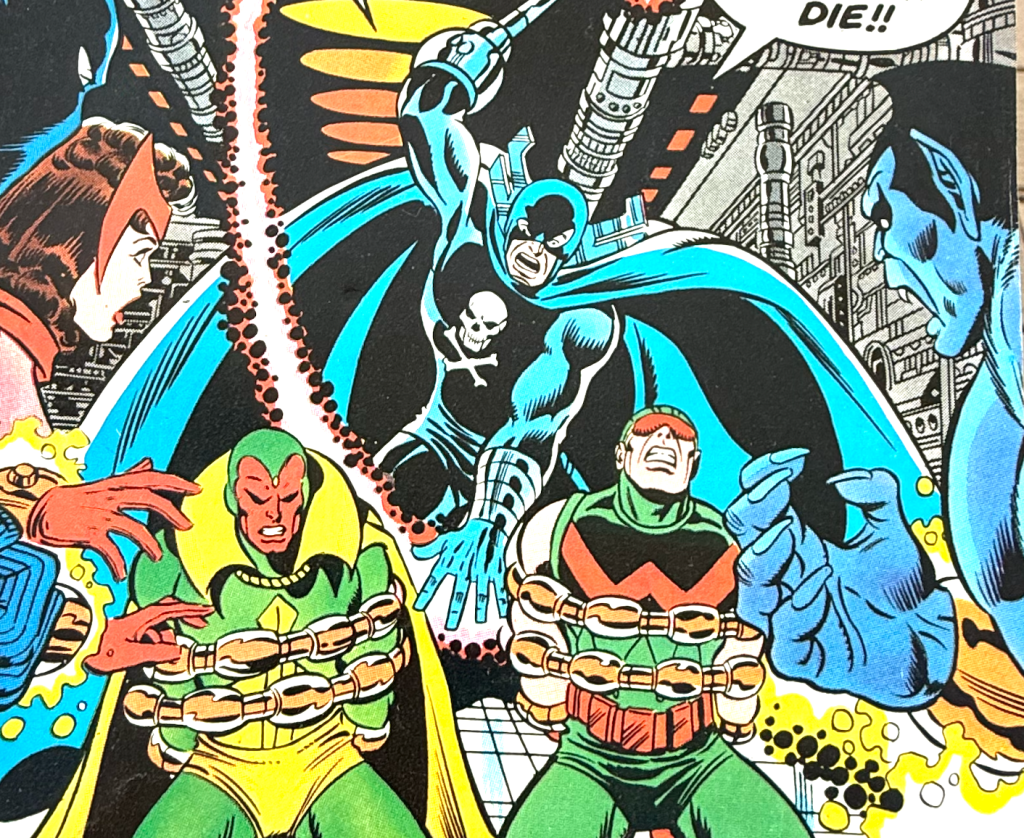
Jim wrote on one of Marvel’s flagship comics, the Avengers. Long before they were cool and in the movies, they were colorful and sitting on a spinner rack at your local supermarket. One of the first issues I bought off such a rack was Avengers #160, cover-dated June 1977; the story was titled “The Trial.” This little book, at 30 cents, still means a lot to me. Lots of emotional connections! Here’s the cover of my copy.
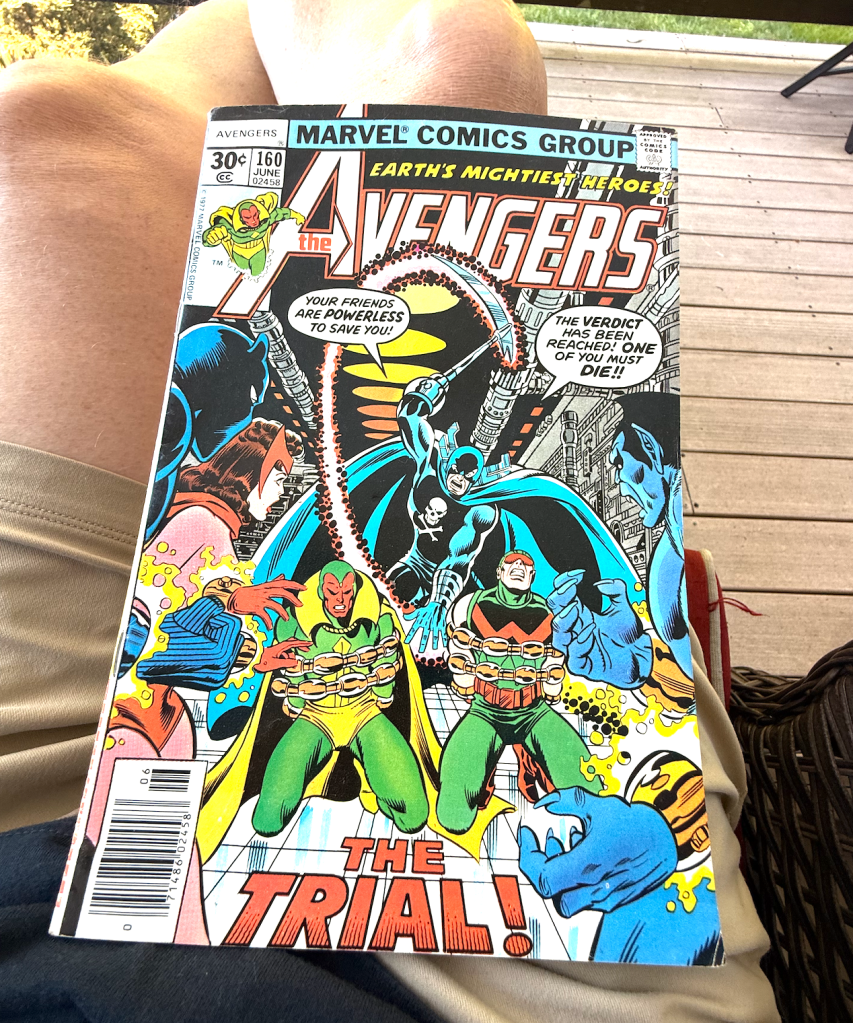
But why? I know the art was great; the late George Perez was phenomenal. I adore the energy, the layouts of each page, the energy, the emotion, etc. It surely was part of the draw.
But the story, and Jim Shooter. It was the story.
The comic — in a very comic book way — tries to give context to the complex relationships between two characters, the Vision and Wonder Man. His name is Simon Williams. Wonder Man was a man who was a failed industrialist that some other villains used as a pawn to try to destroy the Avengers. Back in the 10th issue of the series, but he betrays the villains and dies saving the Avengers. The Vision is an artificial android being that was later imbued with Wonder Man’s brain patterns — he literally had Wonder Man’s brain. Well, years later Wonder Man comes back to life and sets the Vision on a crisis of soul. Who is he? Is he just an artificial being? Does he have a right to live? Is he nothing?
What was it about this comic? I reread it again this morning. It was probably (1) the way it tied up some 15 years of backstory in one issue, (2) showed the significance of all the characters, (3) was personal and relatable, and (4) had stunningly good art.
Please endure the following two paragraphs of “nerding out…”
We learn much earlier in the series that the Vision has a soul and a personality. He is sentient. He has emotions. Even an android can cry. He grows as a person, eventually taking a wife. He is a being that is very unique in the world. He works through many problems between Avengers 57-159. Comic books are a bit soap opera-like at times, but the characters draw you if produced well.
This issue sets up an encounter with Wonder Man’s brother — a maniacal villain who has tried to kill the Avengers in the past to find revenge for his apparent death. The crux of “the Trial” is to determine if Wonder Man is really his brother who has come back to life, and if he truly is, to eliminate the unnecessary and “superfluous” android Vision (I learned the word superfluous by reading this comic, so educational).
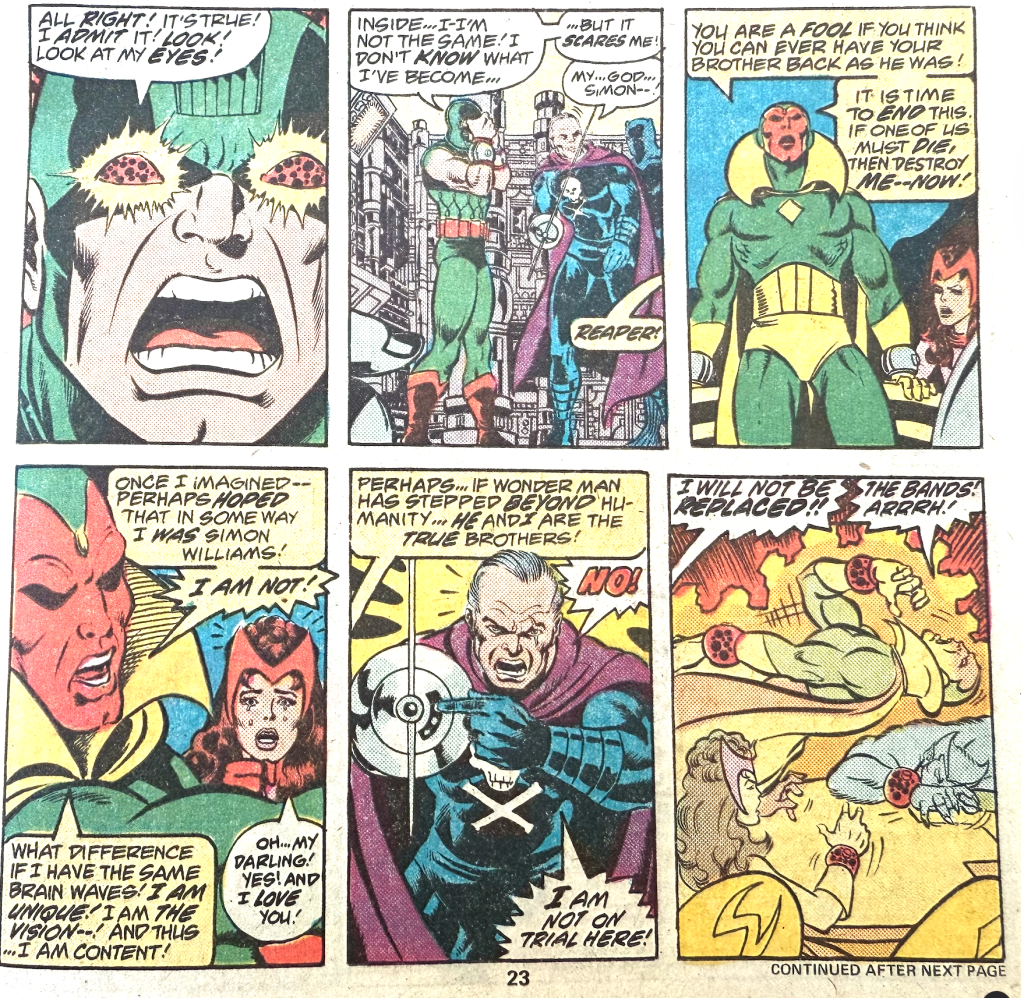
By the end, we find that all beings are important, and that the choices we make are what make us who we are and valuable (or not). Simon Williams chose to repent of bad actions and not kill and save others and give his life. The Vision, although similarly created to hurt and maim and destroy, chose to befriend, rescue, and fight for justice. These choices made them important beings, and Simon’s brother — the evil Grim Reaper — made choices that made him what the Old Testament might refer to as a worthless man. Note: even worthless men can find grace and change their direction.
I always find ways to link what I read or enjoy back to Scripture. It’s good to do so, and I try not to be too annoying about it, but if I were to write about something, where else would I go?
There was an encounter in the Gospels that goes like this…
“While he was still speaking to the people, behold, his mother and his brothers stood outside, asking to speak to him. But he replied to the man who told him, “Who is my mother, and who are my brothers?” And stretching out his hand toward his disciples, he said, “Here are my mother and my brothers! For whoever does the will of my Father in heaven is my brother and sister and mother.”” (Matthew 12:46–50, ESV)
Jesus recognized that it was much more than flesh and blood that made connections between people, and particularly between him and others. To be brothers of Jesus meant to be people who “did the will of the Father.” To trust God, to confess their sin, to do what was right; these were things that made for connections that go deeper than blood.
It isn’t a person’s birth status that makes them who they are; people can be of noble birth and very common in behavior, people can be beautiful and yet mean and unkind. It is not your race, your religious affiliation, or your age that gives you status in God’s eyes. It is obedience to God — do you love the Lord your God with all your heart and your neighbor as yourself? Are you about your agenda (arrogance) or about his (humility)?
I think as a kid I saw that the two heroes were more “brothers” than either was with the villain — the Grim Reaper. They respected others. Reaper did not. This was his choice, but it was not a good one.
Go pick up a copy; back issues of this one shouldn’t be expensive. Or download the Marvel Unlimited app and read it.
And thank you, Jim Shooter. For the story you gave to an 11-year-old boy who needed it.
P.S. / Jim, this is one of my daughter’s favorite comic books too. So you touched the heart of a girl who was -27 when you wrote it too. Thank you for that as well.





 First Hand Truth
Leave a comment