

Psalm 19:7 / The Restoration of Your Soul
Rick McNally / July 7, 2025
The Bible does not thrill, the Bible nourishes. Give time to the reading of the Bible, and the recreating effect is as real as that of fresh air physically. Oswald Chambers
The more you read the Bible, and the more you meditate upon it, the more you will be astonished with it. Charles Spurgeon
To study the Bible. To give it our time and our attention. It is good.
It should be good. Sometimes it is. Experientially speaking. But sometimes not.
It should hit us like an encouraging note from a friend in a time of need. It should hit us like a love letter. It should be longed for like a deer panting in the forest for a refreshing drink. It should be something that changes the atmosphere.
I was at a retreat for pastoral recovery a few months ago. I had just finished a great group session and walked down the stairs heading to the door. You bypass a counter where the mail for the day is laid: packages, letters, etc. I live only a few miles from this facility, and while most of the people got mail, I never did. Charlie Brown moment. But this day, I did! One of my daughter’s good friends (and someone like a second daughter) sent me an encouraging note, and it was a precious possession. I didn’t care what it said; it was joy itself stuck in an envelope.
Scripture does hit that way. Sometimes.
Sometimes it comes across as dry history, stuffy rules, and blah blah blah. Even to me, a Bible student. I am sorry to admit it. But it is true.
Bad Examples of “Delighting in Scripture”
Perhaps this is because of the misuse of Scripture; people using it to stand on to be superior to others, people who use it to belittle, command, confound, and manipulate other people. Such uses of Scripture are anathema.
- Scripture was designed to set men free, not put them in chains.
- Scripture was designed to bring healing, not pain.
- Scripture was designed to heal people in sin, not be more reasons for healing to happen.
The Scribes and Pharisees of Jesus’ time were the misusers of spirituality and the some of the first purveyors of “church hurt” or “spiritual abuse.” They found a way to focus on the greatest book of all and make it a thing that caused more harm. Anything can be weaponized: the Bible, the church, a ministry, anything.
Well, as you probably know, Jesus had much to say to these “Scripture abusers,” and much of it is in Matthew 23. Herein lies a bad example of “delighting in Scripture.” A careful study of these pages of Scripture would be warranted for all of us, particularly those who desire to be leaders in the church. The main critiques of Jesus to them were that they were artificial (hypocrites) and showboats (doing things to be seen by others) who loved acclaim (the acclaim of men). The Scriptures to them were means to their self-aggrandizement, not God’s means of help for the people they presumably were supposed to be serving.
Greatest of all, they usurped God’s role in people’s lives. God alone should be certain things in people’s lives, and they wanted those things for themselves.
- God should be to each person their teacher (Rabbi), there should be no other. For they were all each other’s equals (23:8).
- God should be to each person their authority (Father), no other. For they all had one Father in heaven (23:9).
- God should be to each person their guide (instructor), not any man. For they had one instructor, Christ Jesus the Messiah (23:10).
What follows this is a description of humility and one of the greatest “burns” in all of Scripture as Jesus levels their misuse of people and Scripture into a pile of rubble. You have to destroy sometimes before you can build. This is a brutal text. It is not fun to read.
I would suggest that it is these things above that lit Jesus’ fire. The Scribes and Pharisees were using Scripture and their positions to steal from him his role of teacher, authority, and guide. They were bad teachers, poor examples of authority, and blind guides.
Religious people who use their roles of authority to come between people and their rightful relationships with God are hazardous to our health. We must not become this. We must desire more accountability and not less. We must be more truthful with each other. We must humble ourselves before each other.
Scripture says these people enjoyed the learning of Scripture but lacked many necessary components.
- They lacked faith / James 2:19-20 / Hebrews 11:6 / Eph 2:8-10
- They lacked heart / Isaiah 29:13 / Matthew 15:8-9 / Jeremiah 24:7 / Psalm 51:10
- They lacked obedience / Luke 6:46-49 / Matthew 7:21-23 / Matthew 23:27-28 / Titus 1:16 / Romans 2:13 / James 1:22-25
- They lacked the Holy Spirit / 2 Timothy 3:5 / Romans 8:9 / 1 Corinthians 2:14 / Jude 19
- They lacked love / 1 Corinthians 13 / 1 John 3:14-15 / Romans 13:10
I guess sin can enable men to warp even the best of things. Knowledge puffs up, and knowledge of Scripture can do the same; men have used it through the ages to build themselves up, tear others down, and to coronate themselves into leadership. Such was not God’s intent; this is so clear in Scripture (Mark 10) as Jesus himself showed servanthood to be the proper stance of leadership.
If you have been hurt by people who use their authority in these ways, know that Jesus himself is on your side. He is against that behavior too. He was way harsher toward these kinds of people than he was women caught in adultery, the dreaded tax collectors, or the unwanted Gentiles of his day.
Delighting in Scripture should be something more. Beware these things.
Why Do People Twist Scripture?
People twist scripture for the simple fact that it is entirely spiritual, and people are not so. Paul called the fallen human state “the flesh.” When scripture is viewed from the perspective of fleshly thinking, it is anathema to a person. Bits and parts might be fine, but the overall message is contrary to the heart and mind buried in the influence of the flesh.
Paul puts it this way, through inspiration of the Holy Spirit, in two powerful passages:
For the desires of the flesh are against the Spirit, and the desires of the Spirit are against the flesh, for these are opposed to each other. Galatians 5:17
For those who live according to the flesh set their minds on the things of the flesh, but those who live according to the Spirit set their minds on the things of the Spirit. For to set the mind on the flesh is death, but to set the mind on the Spirit is life and peace. For the mind that is set on the flesh is hostile to God, for it does not submit to God’s law; indeed, it cannot. Those who are in the flesh cannot please God. Romans 8:5-8
The words here are important:
- Against / a preposition denoting “opposition”
- Opposed / antikeimai / to be opposed not only in attitude but also in corresponding behaviors. Against, stand against.
- Hostile / echthra / ill will, hostility, hatred for, discord
- Does not submit / cannot submit / put oneself under the authority of another
The message of Scripture must be twisted or tainted by “natural men” because they do not like the truth of scripture — they are against it, they are opposed to it, they are hostile to it. They cannot submit to it.
If people are twisting and tainting Scripture, it is a good sign that they are living in the flesh as believers (spiritually immature) or they are not believers whatsoever. God will be the judge of that, as Christians try to be discerning (determining what is true and what is false) not judgmental (condemning others outright because they do not agree with you).
Let’s talk positively for a bit, for all this negativity can get us down.
Delighting in Scripture
We are told that the proper attitude toward Scripture should be one of delight. The word hmd gives the idea of “to be desirable — to be worth having or seeking or achieving” in the Lexham Logos Exegetical Guide. A thing that is “delighted in” is something that we desire, take pleasure in, is dear to us, is treasured.
As the Psalter is unfolded in a reading of the many Psalms, we see this attitude brought forth by the psalmists, whose words mirror the Messiah and speak of his coming. This is the heart of Jesus, to love the Word of God. Why? Because it shows and echoes his very soul.
Jesus delights in Scripture. It is his default.
This is seen in three particular places in the Psalms:
- Psalm 1
- Psalm 19
- Psalm 119
In Psalm 1, the word of God, the Law, was to be delighted in at the expense of all other ideas, philosophies, and critics. The Psalmist loves the Word, and is like a tree planted by a stream, gushing with life.
There is a sense of singular delight. No other source of truth should we seek.
In Psalm 119, skipping Psalm 19 for a moment, we see a massive 22-stanza work of 8-verse-long pieces of poetry that seeks to express the multifaceted wonder of the Word of God. It is probably best consumed in smaller bites. The Word is a wonder to be delighted in, and that word is used 10 times as he encourages us to love it too.
I will focus on Psalm 19 for the rest of this article, and we will examine it and try to gain a new passion for the Word of God.
Psalm 19: Delighting in the Word
Just as Psalm 119 is a lot to swallow in one setting, so is Psalm 19. Not because of the length of the text, but the depth of its explanation. The centerpiece of the Psalm is the middle part of the chiastic structure that focuses our attention on verses 7-11. Here the Psalmist focuses our attention on qualities of the Word of God and its ability to act in our lives if we let it.
There’s a lot going on in this Psalm that we won’t cover (1) the explanation of general revelation and its daily speaking to us (2) our response to the word of God, our application, and more. I will focus on the middle piece.
There are nine reasons to delight in the Word of God given. I will mention all of them, and then we will, for the sake of time, delve into a few of them more deeply.
- It is complete (without fault) / it can restore us.
- It is solid (supportive) / it can make fools wise.
- It is just (fair, kind) / it can make our hearts glad.
- It is faultless (free of error) / it can illuminate and brighten our eyes.
- It is morally pure (without moral fault) / it pushes us toward eternity.
- It is dependable (tried and true) / it makes us righteous.
- It is valuable (more than gold) / it is worth our investments.
- It is sweet and pleasant (like sugar) / it is desirable.
- It is both a warning and a promise of reward / it has vast benefits.
Quite the list. There is nothing in our world that is like this. Everything we sink time into is, in comparison, a black hole.
Some of us can get too deeply wrapped up in politics — but no party or candidate is these things. They are singular. It is singular. He is singular.
Some of us can get wrapped up in movements or ideologies — none of them can compare to this. They promise what they cannot deliver.
Many of us go to churches — they cannot compare to this. Church is good, but church that gets in the way of your relationship with Christ is counterproductive. This can happen.
This is a list that is perhaps, in some people’s minds, too good to be true. But it is accurate. The Word of God is this. It is this way because it mirrors and points to the character of the Father and to the person of Jesus. This is who he is. All else is faulty, but Christ is something else.
Turn to Jesus. Don’t follow the broken ideologies of our world; rather, follow someone real, true, and good. Turn to Jesus.
Let’s consider the first one and look at the others at a later time.
The Law of the Lord is Perfect, Reviving the Soul
This is the text of Psalm 119:7a.
You and I should desire and long for scripture because it can fix us!
The Law of the Lord is a perfect thing. It is complete. It is lacking in nothing. It is blameless. It mimics Jesus because it speaks plainly of Jesus. Jesus is our healer, and he uses the Word as the scalpel, as his prescribed medicine, as his stethoscope.
This characteristic of “perfect” speaks of the sacrificial lamb (Leviticus 22:21); it is God’s very being (2 Samuel 22:31). It describes what integrity looks like as we attempt to mirror him (Proverbs 28:18), and the opposite of the fake devotion of the Scribes and Pharisees mentioned above. It takes perfection to fix the broken. Jesus alone can rescue us in our human sin, whether we have never met Jesus or we have been trying to walk with him for dozens of years. Jesus is the only doctor that—in the end—matters.
It is a complete thing that provides for our soul so much. It is historical, letter-like, poetic, and so much more. It spans many years and cultures and tells of the love of God working through many broken people. With a touch of faith, they find God to be beyond their reckoning and capable of reviving them.
The word for reviving is a word that means “to return” and is translated various ways as we see someone who comes back from a journey, changes his mind, or is restored in a relationship to something. 85 times in the ESV, it is translated “restore,” which is the idea here.
Every day, we need to be restored. There is always something broken. In my life, I feel that more and more. God can revive you and me.
The heart of the Psalmist calls out for restoration.
- Psalm 14:7 / When the Lord restores the fortunes of his people, let Jacob be glad…
- Psalm 23:2 / When we walk in the valley of the shadow of death… he restores my soul…
- Psalm 51:12 / When we commit a sin and repent in truth… he restores the joy of salvation…
- Psalm 53:6 / Salvation for Israel is coming… God will restore the fortunes of his people…
- Psalm 60:1 / When we forget God and repent… you have been angry; oh, restore us.
- Psalm 80:3, 7, 19 / The cry is given “restore us.”
- Psalm 85:4, 126:1-4, Psalm 126:4 / “Restore the fortunes of Israel.”
The cry for restoration is real. In Israel, during the history of much of what is quoted above, it was during dark, dark times. Israel and Judah, in turn, were both decimated and taken into captivity. Though many of our times are dark and hard, nothing could compare to this.
Yet there were people who found their restoration in him.
This is echoed in the New Testament, which has this wonderful promise to the suffering ones of Peter’s time: “and after you have suffered a little while, the God of all grace, who has called you to his eternal glory in Christ, will himself restore, confirm, strengthen, and establish you (1 Peter 5:10).
I have felt over the last 8 months more trouble and pain than I have in any other time of my life. A few years ago it was hard when my son was diagnosed with leukemia, and I felt that pain more like a stab wound that needed to heal; but it was not like this. This felt like a betrayal, like a cancer that weaved into my very soul, like a host of arrows piercing me. None of it lethal, but it all seems malicious just the same.
I needed restoration.
My Personal Restoration
Restoration came in waves. Restoration came partially because I didn’t give up. God kept poking my heart, and I kept responding in little ways. Not perfectly. Oh, no.
It came first in the wave of reading books about the struggle I was going through and listening to others who went through similar things. This was healing. I couldn’t read scripture at this point; it hurt too much. Scripture was out of my league.
Secondly, through little glimmers of scripture studied in broken ways. Psalm 46 was like an anchor to my soul. I read it. I thought about it. The singular voice of God was what mattered. Nothing else. No one else.
Third, through the encouragement of others. Some people I knew were of no help; they were a negative impact. Others came to me with gifts and notes that woke up my soul.
Fourth, it came through talking it out with a therapist. Putting it into context. The word of God was in these meetings, and it was all I could chew on. I was betrayed, lonely, weary, anxious, depressed — and that was on a good day.
Fifth, it came through Alongside. This organization helped me put context to my context, words to my inability to speak, grace to my graceless situation, and more. The Word was in this as well. These two sentences cannot summarize what I could write a book about.
Sixth, I have come out of much of myself, have begun thinking of others again (like I want to), and have begun taking greater steps into Scripture; it has been my joy and my strength and my therapy. To read it again like I used to, to study it with a passion again, has begun to finish my recovery. I have studied, I have recorded my study for others, and this has been a very good thing.
Souls get hurt in life. Hurt by others. Hurt by our own actions. Hurt by things that we cannot even explain.
The Word (The Lord) can restore your soul. We each need this to some degree or another.
Are you willing to delve into the Word to find your relief? Would you rather just complain about it? Would you rather just suffer?
Delight in the Word, and be restored! Sounds easy. But there is some work involved.
Application
I want you to delight in Scripture. Not because it is a host of trivial facts and figures and such, but because it is something that can restore you. He will!
- Admit you need some form of restoration; this is on a continuum. Some of us need an overhaul, some of us need a smaller reform. Admit this to God, first and foremost. Write it out. Write it out to Him.
- Share this with a trusted friend. Accountability.
- Find passages to study in Scripture that relate to the issue that is haunting you. Find the passages and study and ruminate on them. Immerse yourself in truth, I can help with this if you need help.
- Try to listen to the words of Scripture; let them seep into your soul. Apply the words you read, let them change your mind, let them change your attitude, let them change your actions.
- Pray to God about your weaknesses, confess them to Him. Pray for wisdom.
- Do this without pretense, for no one’s pleasure but God’s alone; have faith in Christ, do it from the heart, not the head only, seek obedience, submit to the Holy Spirit, seek God’s love for you.
- Share this too, with a friend.
May God bless your pursuit of Him, even when you don’t know what to do. He can help if we let Him. It’s hard for us to admit that need.
God help us. Restore our souls.
Let Jesus be your teacher, pastor, and friend!
There are 8 more benefits of scripture given in Psalm 19, and they will be covered in future blogs. Go see what the Scripture says about these things!
Handout to Study
Sermon PDF Notes
These may be different that what was preached on 7/13 as I was still prepping.



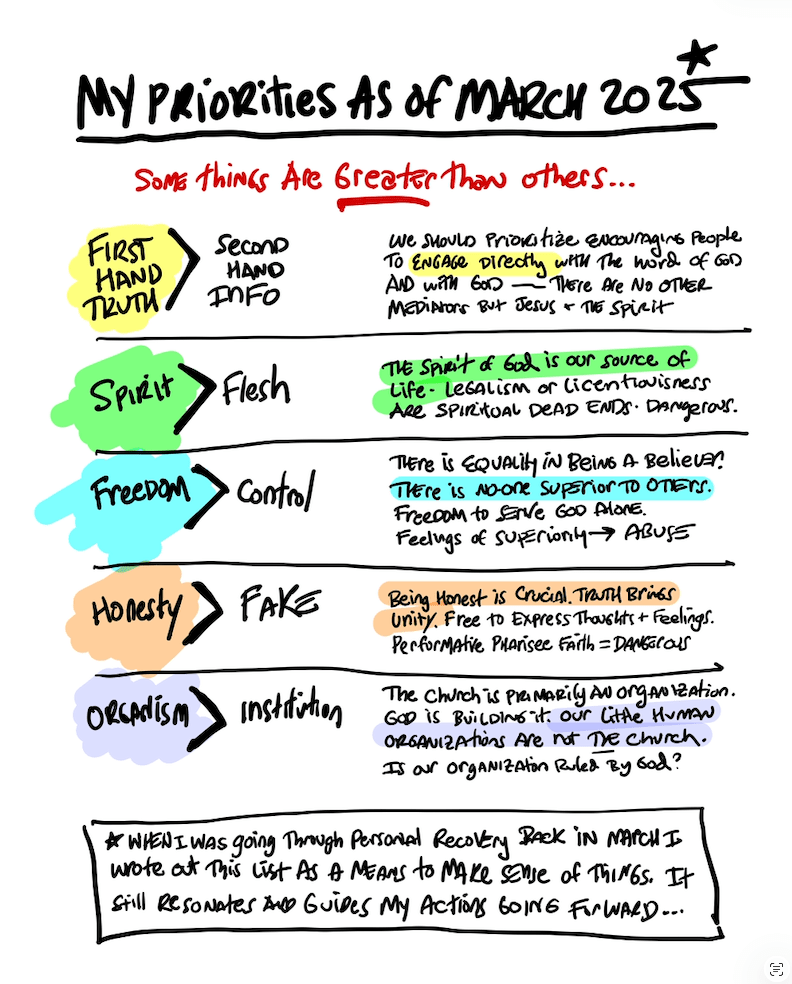

 First Hand Truth
Leave a reply to Sophia Grogg Cancel reply