

God gave it to us. Why do we avoid it?
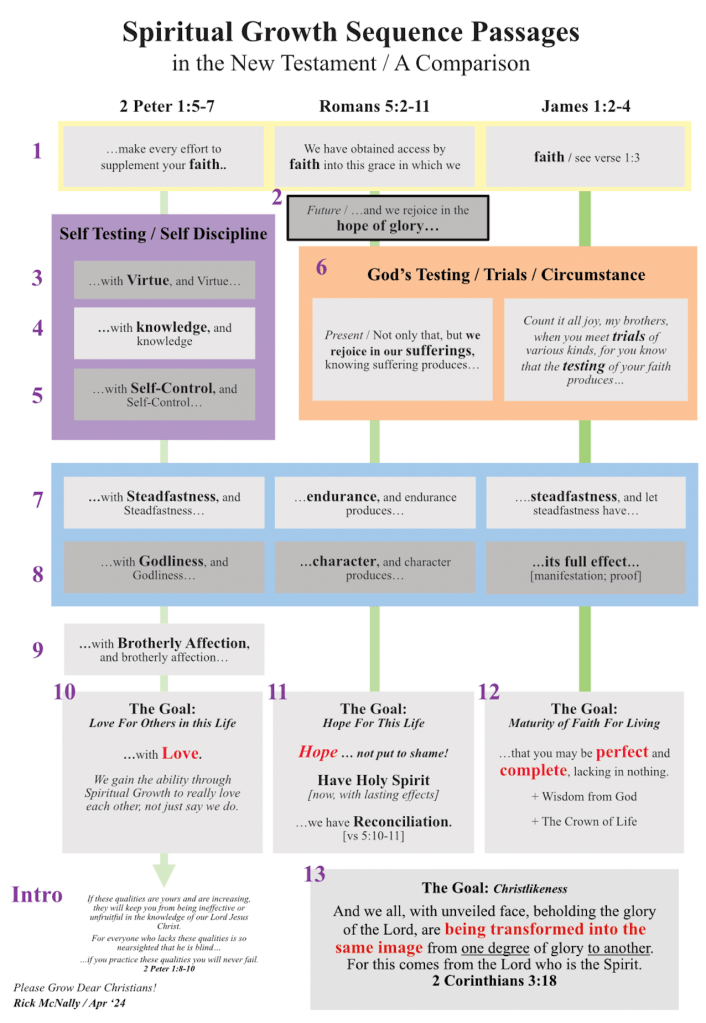
Meshing 2 Peter 1:5-7, Romans 5:2-11, and James 1:2-4 / also 2 Corinthians 3:18
We know how to grow grass seed. We know how to make lasagna. We know how to do so many things in life. Yet, we are not interested in God’s means and methodology for growing in our faith.
It begins with faith; faith in Christ.
The seed of faith is implanted in us in order to grow, not stagnate. If you or I find ourselves at a place where growth is not happening, I would encourage you to take some steps. No one can take these steps for you. No one can take these steps for me.
A few years ago, I noticed that there are three New Testament passages that deal with growth and growing and show a kind of pattern. I began writing a book on this topic last summer and found myself waylaid. I still want to get back to it, but today I want to look at it in summary form.
Of course, this is not a strict “do this” — “get that” kind of pragmatic thing. This is a system that works within the mysteries of the workings of faith, the workings of God, the workings of the Holy Spirit. It is not a legalistic “how to” but a spiritual process of desire, education, and renewal.
We Begin with New Life in Faith that Leads to Eternal Glory
[1] God begins our work in faith.
It is He that has done the necessary steps in order to save us through the death, burial, and resurrection of Christ. He breathes into us new life. He washes us. He forgives us. He makes us alive.
[2] Our future glory is a wonderful motivation.
While things are hard on earth, we know that the future is brighter and that the struggles of earth are producing in us something greater than the pain we go through. Like an Olympic athlete who trains and gives her life to a discipline, the future has a gold medal prepared for her. Not every athlete who trains wins this prize, but those who do — in Christ — will be blessed by such.
The Growth Catalysts of Personal Desire and/or Recovery from Trials
[3] The pursuit of virtue /
The realm of motivation / God help me grow!
Peter tells us to add to our faith virtue. The word in Greek doesn’t mean “good actions” or “good works” but rather adding a “desire to greatness.” This is about wanting to be more and progress in our faith.
To desire greater, to desire more. To want to “be” what we are not yet. A push to desire to grow, desire to progress, a desire to be “great.”
God wants us to desire more in our life. To be more like Him. To be less like we are in our sinful nature. The motivation also might be driven out of a desire to recover or renew from a trial we find ourselves in or have caused.
Example: Lord, I want to learn to love my enemies.
[4] The pursuit of knowledge
The realm of truth / God help me know how to grow!
We add our faith and virtue, knowledge. This is obviously not just generic knowledge such as 2+2=4 or the boiling point of water, but rather spiritual knowledge developed by a pursuit of the Word of God.
The benefits of the Word of God are numerous. If God did leave for us His Word, are we going to be bright enough to listen to it?
Example: Lord, what examples of loving enemies or teachings about loving enemies are in Scripture? When have other Christians struggled with this or overcome it in history? Research. Learn.
[5] The pursuit of Self-Control
The realm of overcoming our sinful will / God help me to constrain my own stubbornness.
We then add to our faith, desire, and knowledge the discipline of obedience. This is where the rubber hits the road. This is probably the most difficult part. But we have our faith! We have decided to do something about it! We have found out what God thinks about our lives and how we can grow! Now we find ourselves
Example: With all the knowledge of the step above, what should I do with my thought life, what should I change about my behavior?
[6] The problem of Trials
The realm of overcoming hardships / God help me through, what are you teaching me?
Trails are hardships that come into our lives. We will have trials. They will come. They will totter our ship to the point of tipping it over. They will cause us to be discouraged.
Both Romans and James tell us to build a sense of joy into our trials. Both passages state that the trials we go through are not without benefit — they are not just junk that happens to us. They are God’s gym.
They are part of the process.
Let us look at trials as a means of growth. If we caused the problems, let us repent. If we are the victim of a trial caused by someone else, we will have to work through those complex feelings and thoughts.
This is worth a lot more discussion, but that is for another day.
Example: Let the trials drive you to prayer, to the Psalms, to a desire to grow.
[7] The Longevity of Steadfastness
The realm of patiently enduring obedience or trials, to the point of surrender of will and the death of self.
The apostles would have us add to all the things we’ve already gone through a sense of consistency and patience in our pursuit of him, in our desire to be something more than we were.
This is added to all that comes before and it seems to be the place where God can work in our hearts with impunity. Keep going. Keep going. Keep going… God will do something in your life.
He will make it so.
Example: Keep on keeping on. Don’t give up. Keep thinking about scripture. Keep yourself in check. When you fail, confess. These little failures are not failures. They are part of the process.
I tried using a wave board this week, tried to learn balance. I failed a lot. I couldn’t even stand up and felt horrible at one point. Little “failures” that were learned from become success.
Results
[8] The results of godliness and character
The realm of “built character” from the Spirit of God.
Until this point, it seems that there was a pursuit of something that wasn’t there initially. The other steps were like the planing of the seed and the initial watering of the seedlings. There was a desire for growth, there was the preparation for growth, but the growth had not yet shown.
Here, godliness and character show up.
We could just pretend before, pretend the things that we want to change. Here is desire + knowledge + self-denial + keeping at it = godly character.
And we’re not done yet. It seems that we learn to love each other a bit more in this as God develops rudimentary love, brotherly affection [9].
[10, 11, 12] The Results
The realm of some significant results in three categories
True love is not easy, it is not the default — it is Godlike, thus perfect. We are not people of love, we are a people who should aim for love, fail and confess, and keep standing up again and again. This proceeds from the Spirit and not our human souls.
Hope is misunderstood. It is the idea of looking at the negative and seeing that God might have more in mind than we can understand — we have hope in a future, in an eternity, that doesn’t match our eye-sight or our experience.
The third goal is perfection, or completion. These don’t mean “perfect” as in without fault, rather they convey the idea of maturity. Maturity is truly never reached in this world. God would have us pursuing and desiring something more. We are back at the beginning.
[13] Looking more like Christ
Here is a great verse that describes this process. It is happening. If we cooperate with it, it will be more effective. If we fight it, it will be less.
And we all, with unveiled face, beholding the glory of the Lord, are being transformed into the same image from one degree of glory to another.
For this comes from the Lord who is the Spirit. 2 Corinthians 3:18




 First Hand Truth
Leave a comment