

Isaiah’s Servant Song / Passage 2
Isaiah 49:1-13 / Rick McNally
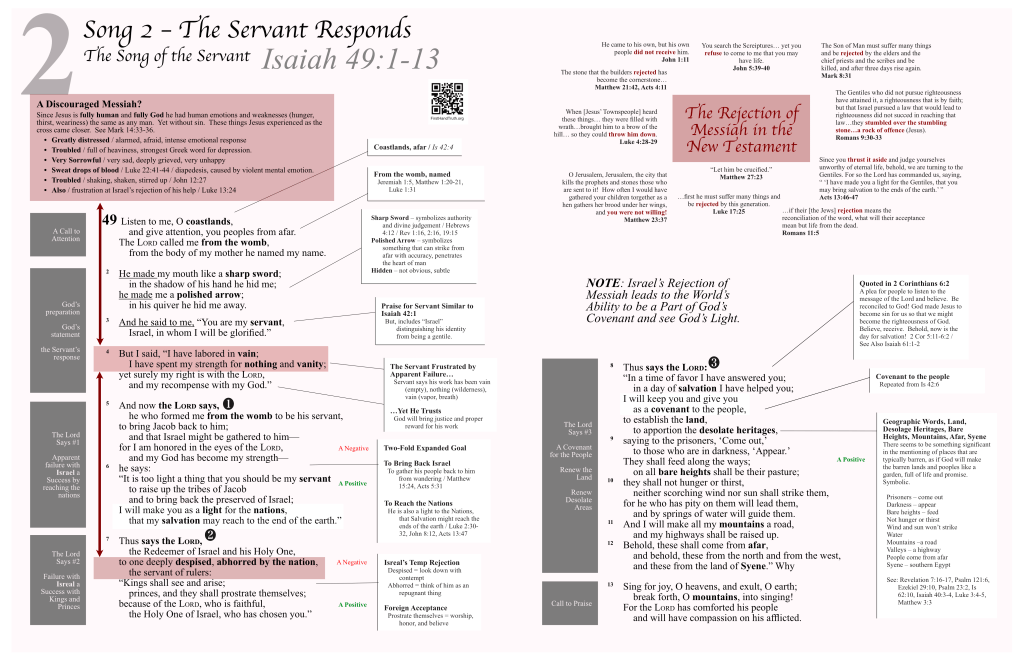
What are the implications for us if the perfect Servant, the Messiah of God was sometimes discouraged?
Hope. It isn’t easy to come by. It stands elusive in our lives as we watch our dreams often crumble, or friends drift away, our family slowly fade away.
Hope for Isreal had flown, too. Their whole country was taken into exile and most of their families were scattered to the wind. They lived at the whim of a foreign king. Their dreams of Messiah scattered across the desert the seperated them from God’s promised land – the one he gave them forever. Didn’t seem to last forever.
But there was a promised King from the faithful line of David. But, David himself and his offspring seemed to be a bit of a mixed bag. Sometimes resplendent, sometimes bawdy and broken. Where is the promise of a Messiah? Where? When? How?
There was very little hope. Just a seed of hope whispered in the mouths of a few prophets, but sometimes they seemed like a crazy lot.
Isaiah talked a lot about Messiah. He talked about babies being born to virgins, One who would be a wonderful counselor, a prince of peace. By the end of his book he painted a picture, or better “sang a song” about this Messiah.
In the first verse of the Psalm (42:1-9) we learn of a faithful Servant of God who was very special indeed. It was this Servant that would bring forth Justice not just to Israel but to the nations. But this one would not be a conquering lord but a Servant of kings, one who would not “break a bruised reed” nor “quench a faintly burning wick.” This one would be righteous (not godless). God himself would give this Servant as a Covenant that would bring peace to the nations. He would open the eyes of the blind and set prisioners free.
Today we are speaking of the second stansa of that Servant Song, found in Isaiah 49:1-3.
Many of the same themes are echoed, continued and expanded – and a few new ones are added to the melody.
Most strikingly is the sense of failure – of loss.
In the first verse of the Song it was positive and hopeful, with no darkness in sight. It echoed the pictures found in Psalm 2 – the Lord’s anointed ruler of the world that should not be rebuffed. It was a positive piece of poetry with no dark notes.
There was even a line in the first third of the Song that told us that this Servant would not grow “faint or discouraged” until his job was finished. But that itself is a bit of a clue that things could go not as expected.
Another clue is all the talk of God’s help; Yhwh (God’s formal name) would uphold him (42:1), this talk of not growing faint or discouraged (42:4), and God’s taking him by the hand and keeping him (42:6). When a parent tells a child that he’s going to do these things for him the child knows the task will not be an easy one.
How could it? Bringing justice to the whole world. If we had all the human power and all the human knowhow imaginable – this is something that could not be done. When people try to make things better they often make it, unfortunately, worse.
Yhwh tells his Servant that he is his Servant Israel through whom he will be glorified. But the reply from the Messiah’s mount is not as expected.
His response, Messiah’s response, is “I have labored in vain; I have spent my strength for nothing and vanity, yet my justice and recompense (repayment) is with my God.”
There is, here, some discouragement. The Servant feels a failure. The servant did nothing wrong, but something seems wrong. He is a bit defeated.
His purpose was to bring justice to the world and be a light to the nations, but his own people – Isreal – rejected him (49:6,7). It seems as if he has failed at bringing back to Yhwh his own people.
The terms used about their rejection are “deeply despised” and “abhored.” The first word gives the idea of treating something as wothless, and the second means to see something as a detestible, vile thing. His people look at the Servant and are not impressed.
Discouragment
The description of the Messiah’s self assessment of his effectiveness is stark.
- I have labored in vain / empty results
- I have spent my strength for nothing / nothing but wilderness, worthless land
- Spent my strength for vanity / a vapor, a breath
This Messiah seems to have given his all and his all did not seem to match up with the task at hand.
This is an all too human response. We can relate.
How many of us feel this way at times? We do. I know we do, because I feel this way on the regular. As a person who teaches lessons and sermons I feel that sometimes I just didn’t do what I should have, or that I said things that I should not have.
I get discouraged. You get discouraged. Messiah got discouraged. He didn’t give up, but he did get discouraged.
Jesus got discouraged when he walked this earth. He struggled with the lack of faith that his disciples had, wondering “how long do I have to put up with you” or asking them “can’t you pray for just one hour?” These are human responses. Jesus may have been fully God but he was also fully human.
Nowhere else is this seen as clearly as in the garden on the night that he was betrayed. His discussion with his Father is legendary (John 17). In those moments there is also a vast amount of humanity shown by the Lord of the universe.
The Gospel of Mark records the following;
And he took with him Peter and James and John, and began to be greatly distressed and troubled. And he said to them, “My soul is very sorrowful, even to death. Remain here and watch.” And going a little farther, he fell on the ground and prayed that, if it were possible, the hour might pass from him. And he said, “Abba, Father, all things are possible for you. Remove this cup from me. Yet not what I will, but what you will.” Mark 14:22-36
Within this text alone we see the suffering of Jesus on a very human level, the level of mental and spiritual anguish. He’s doing nothing wrong here, he’s just human and humans have biology, and that biology responds with weaknesses toward stress.
Jesus was;
- Greatly distressed / alarmed, afraid, describes an intense emotional response.
- Troubled / Strongs calls this the “strongest” of the three Greek words in the NT for depression. It means to “be very heavy” the root idea here is to be “sated (full up) of loathing.” This is a very heavy heart.
- Sorrowful / very sad, deeply grieved, very unhappy.
- Even unto death / To the point that he thinks he might die from it.
Mental and spiritual anquish are not sins, they are not just you and I not having enough faith – they are you dealing with trauma (from natural events, the sins of others, sometimes in our case our own sins). Jesus himself struggled with the weight of events. Some might say “Well, he was looking down the barrel of the greatest trial in history where he was going to die for the sins of mankind, he had a right and you are not going through that much.” I would respond, yes he was, and yet he was fully God and sinless and still struggled. He struggled so he can help us in our struggling, not marginalize or downplay it.”
Jesus struggled, so he could help us in our struggles. This is true.
For we do not have a high prirest who is unable to sympahize with our weaknesses, but one who in every respect has been tempted as we are, yet without sin. Let us then with confidence draw near to the throne of grace, that we may receive mercy and find grace to help in time of need. Hebrews 4:15-16
Thank God for this today.
From here, travelling back to Isaiah 49 and the second Servant Song, we see that God comforts the struggling of his Servant in suprising ways.
Positives from Negatives
But God sees the positive in the negative. He sees that the rejection of Isreal will be a temperary thing, and that in the meantime the whole vast world will be invited into a new covenant with Yhwh. The people who were “afar off” can now be brought near. This is spoken in a few different ways, which is the bulk of the rest of the Song. We see these sections delineated by the phrase “Thus says the Lord” or some variation.
Three statements
1 / God’s job for the Servant was so much bigger than the restoration of Israel. (49:5-6)
The Messiah was going to bs a light to the nations. This was always God’s desire and the ultimate plan of the blessing of Abraham.
2 / God’s Covenant will cause foreign kings and rulers to come find their peace in Messiah, and the Servant will be their king and at the same time their servant. (49:7)
The rejection of Messiah would in some ways make a path for the reception of the gospel by the gentiles – this was played out in Acts, particularly explained from Chapter 10 onward, starting with Peter on a roof having a dream about a sheet with animals on it. Acts 15 is where they had to deal with this issue that was an elephant in the room at the time.
3 / The whole “land” of the earth will be established anew; freedom from prision, the invisble will be seen, the “desolate” heritages” will be apportioned blessings. (49:8-12)
I am not sure yet whether this passage is God turning his attention back to Isreal in particular, or if this paragraph is melding the gentiles and Isreal into one group or category. Either way, the gentiles have been let in on the benefits of Messiah. Their day has come.
The Messiah, though suffering, is doing so for the benefit of all of mankind.





 First Hand Truth
Leave a comment